Saturday, 1 January 2022

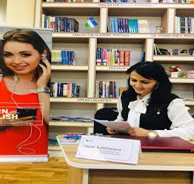
NETRUZ Champion Teacher: Khurshida Eshimova


Hello dear colleagues. I am Khurshida Eshimova. I am from Tashkent. I work at specialized school number 91, Tashkent. I have been working as an English teacher for 13 years. My students are learners of 5-11 grades. I start work at 8 a.m. I love my job and teaching in general.
This year (2021) was very prosperous for me as I got an international TESOL trainer and Uzbek national C1 certificates. I am keen on learning languages. Nowadays I can speak five languages including my native Uzbek language: English, Turkish, Russian, and a little Persian. I believe and apply a proverb in my life: “People can take away everything from you, but not your knowledge”. That is why I do suggest other students and teachers keep on learning as we live and learn whole our lives.

MY RESEARCH INTERESTS

I am interested in innovative ways of teaching English in this digital century, applying It and various apps into the learning process, managing big multilevel and multicultural classes, teaching adult learners as well.

ABSTRACT OF MY RESAERCH PROJECT

I have always been using various activities in English lessons. This makes my lessons alive and more interesting. Moreover, it makes the lessons colourful and student-centred as well. While choosing activities I pay attention to the level of my learners and the objectives of activities or tasks. I think the acceptance and interest of activities vary due to learners’ age and level. Surprisingly, some of my students do not want to participate in some activities. It is sometimes hard to make them stand up from their chairs. That is very strange when I consider the activity interesting, while some of my students find it boring or uninteresting that they do not even want to take part. Due to this reason, I started working on this research. My research focus was to observe the usage of activities in English classes and their effects on my students' motivation.

MY REFLECTION ON THE TRAINING AND EXPLORATORY ACTION RESEARCH

This is the first time I have been working on doing research on a particular topic. I worked with professionals where there was a friendly atmosphere. From the beginning of the training, it was interesting with lots of detailed information and practices along with thorough explanations. The organizer Elyanora led the project; she introduced us to all our mentors who are indeed skilled and experienced. Introductory topics and tasks gradually led and prepared all mentees to plan their own research. As the form of the meetings were online via Zoom, we were given a choice to choose the right and convenient for us. This was especially beneficial for teachers who work in educational organizations like public schools, colleges and universities. In every session, we could gain knowledge and experience about formulating our research. Moreover, we had chances to be a visitor in online sessions where international researchers shared their investigations. It was one of the most effective ways of motivating that Elyanora could achieve. Our mentors worked with us according to our research interests. While working on my action research I realized that I could look at the situation or my lesson from the point of learners and observers. Moreover, when I started searching for reasons for challenging situations in my lessons I stepped forward to the students’ site. I realized that we became closer with my students after those informal talks. I did not pay attention to that earlier before, unfortunately. Besides that, I could understand if we do reflections after each lesson, we will develop and practice our research skills.

I really appreciate and am thankful to NETRUZ, all the organizers, trainers and mentors of the project for giving us a chance to try something new at the same time interesting, self-developing and job-connected activity for our further professional career. I would love to continue researching and practising it in the future with other new topics. In conclusion, I can say surely that I am happy to be a member of the NETRUZ community!

NETRUZ Champion Teacher: Janar Abuova

My name is Janar Abuova. I have been working as a teacher for 12 years. I am a holder of CELTA and TEFL certificates and MA TESOL graduate from Webster University. Additionally, I have finished the CLIL program by NILE teacher training course and OPEN Teacher Training program provided by US embassy. Currently, I am a Senior Lecturer of English at Yeoju Technical Institute in Tashkent. While working at the institute I was one of the founders of the double degree program for Content and Language teachers in Uzb
ekistan. This program is considered unique for Central Asia and focuses on Educating Future Content and Language teachers in Uzbekistan. After launching English Education faculty, I worked as curriculum developer and syllabus designer. Simultaneously, I work as a material designer for the IT park.

My research interests for NETRUZ project.

As a teacher and a researcher, I am interested in investigating methods that could be beneficial for teaching low-level students in higher education, so they could pass their exams without failing. My topic was devoted to teaching academic writing for low level students by implementing a genre approach. I explored the real level of students and how it corresponds with the syllabus of the subject. I investigated students’ perceptions, expectations, needs and hopes for my classes. Also, I observed my colleagues’ lessons with the same group and listened to their comments regarding their observation of my class. Based on this, I implemented new actions to change the way of teaching and tried a genre approach in writing. The research showed that a genre approach is a successful method for low level students while teaching writing. The main reason is that while teaching you are giving input of all necessary elements of writing that is specific for that genre and learner can easily produce efficient amount of writing by integrating writing for learning into the Academic English.

Reflection on training and exploratory action research

At the beginning I was not really sure, what was the project for and how it could be helpful for me. However, after observing their input sessions and having a couple of meetings with my mentor I could clearly see the reason of the project. It teaches simple teachers to explore even the smallest pitfalls of the class and turn it into the benefits. I personally learned that even global problem and difficult situation could be solved if it is correctly investigated and the reason of the failure is properly treated. Therefore, action research can be key of success for the teachers of remote areas with lack of resources or other difficulties as it enhances critical thinking and makes teachers act in order to have productive classes.

NETRUZ Champion Teacher: Jamola Urunbaeva

Jamola Urunbaeva Ikramjanovna is an EFL teacher at Inter Nation English Language School teaching IELTS preparation classes. She taught Grammar in Context, Vocabulary, Writing, Integrated Skills, Discourse Analysis, Listening and Speaking, Language Teaching Course, Teaching Development Course, and ICT in Education when she worked as an EFL Teacher at the “Department of Teaching English in Integrated Ways” at Uzbek State World Languages University for five years. She did two Masters Degrees in English Linguistics at Uzbek State World Languages University, Tashkent, Uzbekistan in 2015 and a Masters of Arts in English Language Teaching at the “English Language Department” of Hasan Ali Yucel Faculty of Education at Istanbul University, Turkey in 2012. She has a Bachelor of Arts degree in English Philology from Uzbek State World Languages University, Tashkent, Uzbekistan, between 2005 and 2009.

Her Research Interests: The Paradigm Shift in Teaching the English Language in Third World Countries, intercultural Competence in Language Teaching/Learning, Experimental Research on the Implications of Current Models and Frameworks at Specific Setting, Collaborative learning, Enhancing communicative skills, Promoting a global community & cultural exchange.

Abstract of the EAR research project

The present investigation is an exploratory action research (EAR) project and was conducted to define and deal with challenging and disruptive students in EFL classrooms. The participants of the study were B1 (pre-intermediate) level General English course students at Inter Nation English Language School in Uzbekistan, and their ages ranged from 13 to 31. The data was compiled through two different questionnaires in the form of students’ reports in order to provide answers to two research questions. First, an exploratory practice (EP) was carried out with the participation of 42 students from three general English classes by using the first questionnaire as the data collection tool. The purpose was to comprehend what disruptive behaviour in the class meant to students and to explore students’ awareness of how they think of challenging and disruptive students in terms of the seriousness level to be dealt with in classes. Following the EP findings, a five-week action research (AR) project was supported in one of the classes with the participation of 15 students. The AR study was the application of the arisen subjects from the EP in the form of accepted student behaviours. Resulting in the classroom enactments, the second data collection tool, which was the second questionnaire, was handed to the students. The verdicts of the second questionnaire delivered the considerations of the students on the AR study. The collected data was content analyzed, and the teacher-researcher provided reflections on the whole development.

NETRUZ Champion Teacher: Guzal Eshchanova

My name is Guzal Eshchanova. I received my MA in Linguistics (English language) from the Uzbek State World Language University University of Uzbekistan in 2007, and BA in Philology (English language) from Uzbekistan State World Languages University in 2000. I have been working as a teacher of 
English in Higher Education for 22 years. Currently, I am a Senior Lecturer of “Tashkent Institute of Irrigation and Agricultural Mechanization Engineer” National Research University. Simultaneously I work as an English teacher at Specialized School on Exact Sciences under the mentioned university. I am also actively participating in various British Council projects, e.g. the Online Teacher Community Team, Change Academy, etc. I also decided to take part in this training to improve my teaching practices.

My NETRUZ Classroom-based Research Project was aimed at identifying proper vocabulary teaching strategies for ESP students majoring in Agricultural Mechanization (students especially with less developed ESP vocabulary).  I have been motivating my learners to overcome various vocabulary learning difficulties, which hinder their proper communication with each other.  My students believe that learning English for Specific Purposes will lead them to acquire speciality-related foreign languages and make them become competitive graduators, which is a demand of the labour market at present. With this in mind, they work hard on themselves and as a supporter, I also assist them to overcome the language barrier by accelerating their speaking skills in English. Thanks to the NETRUZ project I am improving my teaching skills as well as my students’ vocabulary learning skills in my lessons.

In my research project, I explored the reasons why my students (students of agricultural mechanization) use less ESP vocabulary, sometimes even L1 in English classes and the ways to switch them on English in laboratories, where I conducted my classes with the aim to increase the motivation of my students. I started to pay more attention to the way that learners use English with me in the class, even before the audience in the laboratory classes, where different tractor equipment was demonstrated for new guests with the participation of students. It was interesting for me to understand my learners' perceptions and expectations. Additionally, identifying my colleague's opinions about my classes through critical-friend observations was huge assistance for me, as we could find the solutions to the existing problems, that we faced in our classes. I learnt about other ELT teachers' experiences related to my context from different articles and webinars provided by NETRUZ Project.

Reflection on training and exploratory action research:

Overall, within the training course, I was able to develop the methodologies that work in my teaching context and learnt how the learning outcomes might be better when as teachers we feel our readiness to change our approaches in teaching with a big hope for better understanding. 

NETRUZ Champion Teacher: Nozima Mukhtarova


My name is Nozima Mukhtarova Kuchkarovna. I received my MA in Linguistics (English language) from the National University of Uzbekistan in 2021, and BA in Philology (English language) from Uzbekistan State World Languages University in 2005. I have worked as an English teacher at academic lyceums for 14 years and at school for 2 years. Currently, I am a Senior Instructor of the Communicative English Module at the Branch of the Russian State Pedagogical University named after A.I. Herzen in Tashkent. Simultaneously I work as an English teacher at Specialized School N-227.

To develop proficiency skills, I have become a member of the Online Teacher Community Team organized by the British Council. I have accomplished English Language and ELT Methodology Programme.

My research interests for the NETRUZ project:

In the following EAR I am determined to find ways of encouraging my students to interact with each other in English during the classes, to improve their English communicative skills, particularly speaking. I would like to boost confidence in them, help them to overcome the language barrier, motivate and accelerate their speaking in English. Thanks to the NETRUZ project I am improving my teaching skills as well as my students’ attitude to my lessons.

The abstract of my research project:

My topic was devoted to exploring the reasons why my students (students of preschool education direction) use mostly L1 in English classes and the ways to switch them on English. I explored how my students feel while speaking in class to me, to each other and to the whole audience. I tried to find out what are their perceptions, expectations, needs and hopes of the class. Besides, I asked my colleague to observe my lesson and exchanged her opinion on this issue. I learnt about other ELT teachers' experiences related to my context from different articles and webinars provided by NETRUZ Project.

Reflection on training and exploratory action research:

The training was designed in high quality, to develop the proficiency skills of English teachers with the help of triangulation: exploring yourself, your learners and other teachers’ experience. It was unique in terms of exchanging ideas, learning to question appropriately and finding the right answer, approaching an issue from different points which surely serve to be more critical and creative. All mentors contributed with informative presentations, were supportive and motivating. This training helped me to design materials concerning my students’ abilities and preferences, to be open to my students, to let them know that I am not different to their perceptions and expectations. Moreover, it helped me to engage my students in learning English with pleasure and to boost their wish to use the target language more. Overall I benefited from this course in terms of exploring my attitude to each lesson, creating more engaging activities by learning my students’ weaknesses, strengths and wishes.

MOST POPULAR POSTS